When Should You Get an ISBN? Before Formatting, Cover Design, or Publishing?

Introduction
An ISBN is one of the most important identifiers used in book publishing, but many first-time authors are unsure about exactly when they should get one.
Should you obtain an ISBN while you are still writing? Do you need it before formatting? Should it be assigned before your cover designer starts work? Or can you wait until you are ready to upload the finished book to Amazon KDP, IngramSpark, or another publishing platform?
The answer depends partly on what you mean by “get an ISBN.”
You can purchase ISBNs well in advance. ISBNs do not expire, so authors and publishers can obtain them before a particular manuscript is finished. However, assigning a specific ISBN to a book is best done after important details such as the book’s format and edition are known.
For most self-published print books, the practical goal is to have the correct ISBN assigned before the final cover is produced and before the book is submitted for publication and distribution.
This guide explains when to obtain and assign an ISBN, where it fits into the publishing workflow, and how to avoid common ISBN mistakes.
When Should You Get an ISBN? The Short Answer
You can purchase an ISBN at almost any stage of the publishing process, even before the manuscript is finished.
However, you should normally assign the ISBN to a specific book after you have decided its format and edition, and before the final cover and publishing metadata are completed.
For a typical self-published print book, the sequence looks like this:
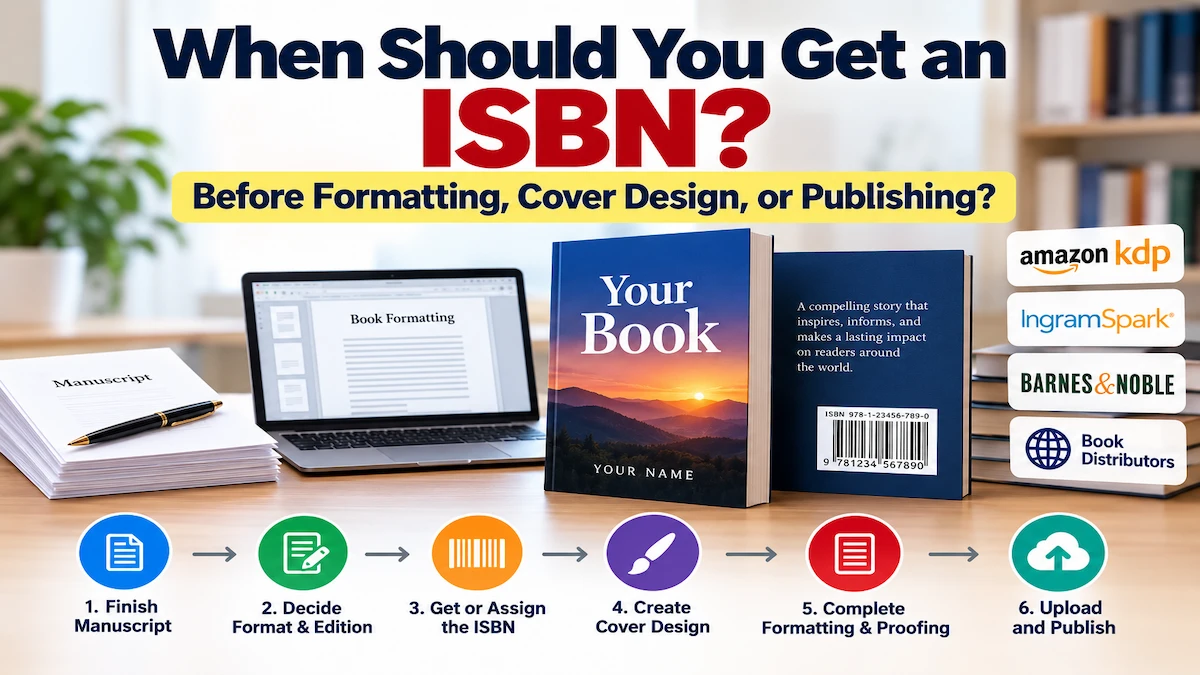
Finish and edit the manuscript → Decide the format and edition → Assign the ISBN → Complete final formatting and cover production → Proofread → Upload and publish
The distinction between buying an ISBN and assigning an ISBN is important.
If you purchase a block of ISBNs from your country’s official ISBN agency, you do not have to assign all of them immediately. You can keep unused numbers for future books.
Once an ISBN is assigned to a particular format and edition, however, it identifies that specific publishing product. A paperback and hardcover, for example, normally require different ISBNs.
For authors using a publishing platform’s free ISBN, the timing can work differently because the platform generally assigns the ISBN during the book-setup process.
The simplest rule is:
You can buy ISBNs early, but assign the correct ISBN before final cover production and before publishing the book.
What Stage of Publishing Should You Get an ISBN?
The ISBN decision fits between manuscript preparation and final production.
The following workflow works well for most independently published print books.
1. Finish the Manuscript First
You do not have to finish writing before purchasing ISBNs.
If you know that you plan to publish several books or formats, you can obtain ISBNs in advance and keep unused numbers until you need them.
However, you generally do not need to assign a specific ISBN to a manuscript while major details are still changing.
Before assignment, it is useful to have a clear understanding of:
- the final book title,
- the author or contributor information,
- the intended publisher or imprint,
- the edition,
- and the formats you intend to publish.
This reduces the risk of assigning an ISBN before you know exactly which publishing product it will identify.
2. Decide the Book Format and Edition
Before assigning ISBNs, decide which versions of the book you plan to release.
For example, you may publish:
- a paperback,
- a hardcover,
- an eBook,
- an audiobook,
- or a revised edition later.
ISBNs identify particular formats and editions rather than merely identifying the general title.
That means the paperback and hardcover versions of the same book normally require separate ISBNs.
Knowing your publishing formats in advance makes it easier to determine how many ISBNs you will need.
3. Get or Assign the ISBN Before Final Cover Production
For a print book, this is one of the most important timing points.
The ISBN should normally be assigned before the final cover is completed because the back cover commonly contains a barcode associated with the ISBN.
IngramSpark advises self-publishers to have the ISBN purchased and assigned before final cover production because the ISBN is needed for the barcode and title setup.
A cover designer can still begin earlier by working on:
- cover concepts,
- typography,
- colors,
- illustrations,
- and the general front-cover design.
However, the final print-ready cover should be prepared using the correct ISBN and barcode requirements for the chosen publishing or distribution platform.
4. Add the ISBN to the Copyright Page and Metadata
Once the ISBN has been assigned, it can be included in the book’s publishing information.
Many professionally produced print books display the ISBN on the copyright page.
The ISBN will also form part of the metadata used by publishers, retailers, wholesalers, libraries, and distributors to identify the book.
At this stage, make sure important details are consistent across your ISBN registration and publishing platform, including:
- book title and subtitle,
- author name,
- format,
- edition information,
- and publisher or imprint name.
This is especially important when using your own ISBN on Amazon KDP. KDP requires the information connected to the ISBN to match the title information entered during setup.
5. Complete Formatting and Final Proofing
Once the book’s identity and publishing details are stable, you can complete the final production files.
This usually includes:
- final interior formatting or typesetting,
- copyright-page information,
- the print-ready cover,
- the ISBN and barcode,
- and final proofreading.
The ISBN itself usually does not determine the visual formatting of the main manuscript, so formatting work can begin before an ISBN is assigned.
However, having the ISBN settled before the final production files are locked helps ensure that the copyright page, cover, metadata, and platform setup all agree.
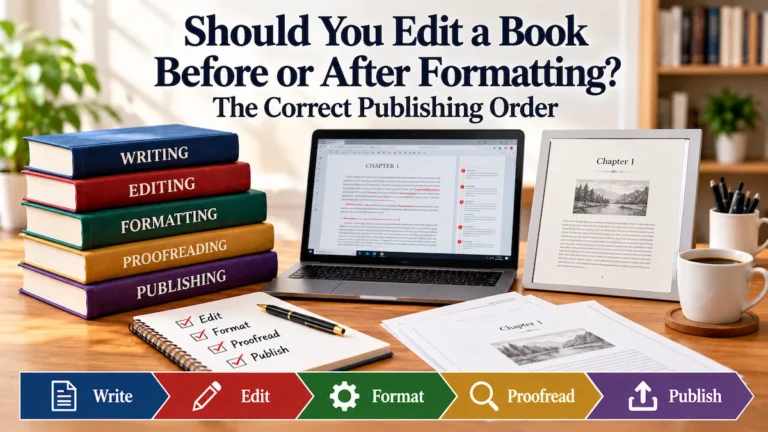
If you are unsure about the correct publishing sequence, read our guide on whether you should edit a book before or after formatting.
6. Upload the Final Files to Your Publishing Platform
The final ISBN must be in place when required by the publishing platform.
For example, Amazon KDP requires an ISBN for standard paperback and hardcover editions. Authors can either use their own ISBN or, for eligible books, request a free KDP ISBN during setup.
KDP does not require an ISBN for Kindle eBooks.
If you use your own ISBN, the information registered with the ISBN agency should match the information entered during publishing.
Once the ISBN, metadata, interior file, and cover file are correct, you can complete the platform’s preview and proofing process before publishing the book.
Do You Need an ISBN Before Formatting?
Not necessarily.
You can begin formatting a book before the ISBN has been assigned because the ISBN does not usually affect most of the interior layout.
For example, the formatter can usually work on:
- trim size,
- margins,
- fonts,
- paragraph styles,
- chapter headings,
- page numbers,
- tables,
- images,
- and general page design.
However, it is still a good idea to have the ISBN decision settled before the final interior file is locked.
That is because the ISBN may appear on the copyright page and may also need to match the metadata entered on your publishing platform.
So the practical answer is:
You do not need an ISBN before formatting begins, but you should normally have it assigned before the final formatted file is approved for publication.
Do You Need an ISBN Before Cover Design?
You do not need an ISBN before the creative cover-design process begins, but you should normally have the ISBN assigned before the final print-ready cover is completed.
A cover designer can begin working on:
- the front-cover concept,
- title and subtitle placement,
- author name,
- typography,
- colors,
- illustrations,
- and the general visual style.
However, the final print cover usually includes the back cover and barcode area.
The barcode is connected to the ISBN, so the correct ISBN should normally be available before the final cover file is prepared for upload.
In some cases, the publishing platform may generate the barcode automatically. In others, the barcode may be included directly in the cover file.
Either way, the ISBN must be correct before the book is released.
A useful workflow is:
Begin creative cover design → Assign the ISBN → Complete the final print cover and barcode → Proof the cover → Publish.
Do You Need an ISBN Before Publishing on Amazon KDP?
For standard paperback and hardcover books, Amazon KDP requires an ISBN before the book can be published.
You have two main options:
- use a free ISBN provided by KDP, or
- use an ISBN that you obtained from an official ISBN agency.
KDP’s free ISBN is available for eligible paperback and hardcover books. If you choose it, Amazon assigns the ISBN during the book-setup process.
A free KDP ISBN can be convenient for authors who want a simple publishing route and do not plan to use that same ISBN outside KDP.
However, it comes with an important limitation:
A free KDP ISBN can only be used on KDP.
If you use your own ISBN instead, you have greater flexibility to use that same ISBN for the same edition on other publishing services, provided the metadata and distribution setup are correct.
KDP also requires the details connected to your own ISBN to match the information entered during title setup.
Kindle eBooks are different.
KDP does not require an ISBN for Kindle eBooks. Amazon assigns its own ASIN to the eBook instead.
So the practical rule is:
Paperback and hardcover: ISBN required. Kindle eBook: ISBN not required on KDP.
If you plan to distribute the print edition through more than one service, read our guide to KDP Expanded Distribution vs. IngramSpark before deciding how to handle your ISBN and distribution settings.
Should You Buy Your Own ISBN or Use a Free One?
Whether you should buy your own ISBN or use a free platform-provided ISBN depends largely on your publishing plans.
A free ISBN can be suitable if:
- you want the simplest possible setup,
- you are publishing only through the platform that provides it,
- you do not need your own publishing imprint attached to the ISBN,
- and you want to avoid the cost of purchasing ISBNs.
For example, Amazon states that books using a free KDP ISBN display the publisher or imprint as “Independently published.”
Buying or obtaining your own ISBN gives you more control.
It may be the better choice if:
- you want to publish the same edition through more than one service,
- you want your own publishing company or imprint associated with the book,
- you plan to use KDP and IngramSpark together,
- you are building a long-term publishing business,
- or you expect to publish multiple books and formats.
When you own the ISBN, you control the publisher or imprint information connected to it, subject to the rules of your country’s ISBN agency.
It can also give you greater flexibility if you later change printers, distributors, or publishing platforms.
The main trade-off is cost.
Some countries provide ISBNs free through their national ISBN agency, while others charge for them. Requirements and pricing depend on where the publisher is based.
A useful rule is:
Use a free ISBN if simplicity and low cost are your priorities. Use your own ISBN if control, branding, and multi-platform distribution are more important.
Does Each Format Need a Different ISBN?
Yes. In general, each separately published format or edition of a book should have its own ISBN.
An ISBN identifies a specific publishing product, not simply the title of the book.
For example:
| Book Version | ISBN |
|---|---|
| Paperback | ISBN A |
| Hardcover | ISBN B |
| eBook, if an ISBN is assigned | ISBN C |
| Audiobook, if an ISBN is assigned | ISBN D |
| Spanish paperback edition | ISBN E |
A paperback ISBN should therefore not be reused for the hardcover edition.
The same principle applies when a book is released in another language. A translated edition is a separate publishing product and requires its own ISBN when an ISBN is used for that edition.
Not every publishing platform requires an ISBN for every digital format.
For example, Amazon KDP does not require an ISBN for Kindle eBooks because Amazon assigns an ASIN instead.
The important point is that you should never assume one print ISBN can be reused across paperback, hardcover, translated, or substantially different editions.
For more detail, read our guide on whether a translated book needs a new ISBN.
Can You Reuse an ISBN for a New Edition?
Usually not.
If you publish a genuinely new edition of a book, that edition should normally receive a new ISBN.
A new ISBN may be needed when the book has undergone substantial changes such as:
- major revisions to the text,
- new chapters or significant new content,
- major restructuring,
- a new language edition,
- or a change to a different physical format.
For example, if you publish a substantially revised Second Edition of an existing paperback, the new edition should normally receive a new ISBN.
However, small corrections do not automatically require a new ISBN.
Minor changes such as:
- correcting typographical errors,
- fixing punctuation,
- repairing minor formatting problems,
- or making other small corrections that do not create a new edition
can generally remain under the existing ISBN.
A simple reprint of the same edition also normally keeps the same ISBN.
The distinction is whether you are correcting the existing product or creating a materially new edition.
A useful rule is:
Minor corrections usually keep the existing ISBN. A substantially revised or newly identified edition normally needs a new one.
Common ISBN Timing Mistakes to Avoid
ISBN problems often happen because authors make decisions too early, too late, or without first deciding how the book will be published.
Common mistakes include:
- Assigning an ISBN before the book format is decided. A paperback and hardcover normally require different ISBNs.
- Waiting until after the final cover is completed. Print covers commonly need the correct ISBN and barcode information.
- Using the same ISBN for multiple formats. A paperback ISBN should not normally be reused for a hardcover or another distinct edition.
- Using a free platform ISBN and assuming it can be transferred elsewhere. Free ISBNs supplied by platforms such as KDP are generally restricted to that platform.
- Assigning an ISBN and then changing important metadata. Major changes to title, edition, format, or publisher information can create inconsistencies.
- Reusing an ISBN for a substantially revised edition. A genuinely new edition normally requires a new ISBN.
- Buying or assigning more ISBNs than necessary for digital formats. Some platforms do not require ISBNs for certain eBook editions.
- Confusing the ISBN with the barcode. The ISBN is the identifier; the barcode is a machine-readable representation commonly used on print books.
- Failing to keep records of assigned ISBNs. Authors and publishers should maintain a record showing which ISBN belongs to each format, edition, language, and title.
A simple ISBN tracking sheet can prevent many of these mistakes, especially for authors publishing multiple formats or translated editions.
Before assigning an ISBN, confirm exactly which publishing product the number will identify.
Frequently Asked Questions
Can I get an ISBN before my book is finished?
Yes.
You can purchase ISBNs before the manuscript is finished, and unused ISBNs do not expire.
However, it is usually better to wait before assigning a particular ISBN until important details such as the title, format, edition, and publisher or imprint are reasonably stable.
Do I need an ISBN before formatting my book?
Not necessarily.
Formatting can usually begin before an ISBN has been assigned because most of the interior layout does not depend on the ISBN.
However, the ISBN should normally be settled before the final formatted file is approved, particularly if it will appear on the copyright page or in the publishing metadata.
Do I need an ISBN before designing the cover?
You do not need an ISBN before the creative design process begins.
However, for a print book, the ISBN should normally be assigned before the final print-ready cover is completed because the back cover may include a barcode linked to that ISBN.
Can I publish on KDP without buying an ISBN?
Yes.
For eligible paperback and hardcover books, Amazon KDP can provide a free ISBN during the setup process.
You may also use your own ISBN.
For Kindle eBooks, KDP does not require an ISBN.
Does a paperback and hardcover need separate ISBNs?
Yes.
A paperback and hardcover are different publishing formats, so they normally require separate ISBNs.
The same ISBN should not be used for both formats.
Do eBooks need an ISBN?
It depends on the publishing platform and distribution plan.
Amazon KDP does not require an ISBN for Kindle eBooks because Amazon assigns an ASIN.
Other distributors, retailers, or publishing systems may use or require ISBNs for digital editions, so authors should check the requirements of the platforms they intend to use.
Does a translated edition need a new ISBN?
Yes, when an ISBN is used for the translated edition.
A translation is considered a separate edition because the language has changed.
For example, an English paperback and its Spanish paperback translation should normally have different ISBNs.
For a more detailed explanation, read our guide on whether a translated book needs a new ISBN.
Need Help Preparing Your Book for Publication?
Getting the ISBN timing right is only one part of preparing a book for publication.
Authors also need to coordinate editing, formatting, cover design, metadata, proofreading, platform setup, and distribution so that the final files and publishing information are consistent.
AB Publisher LLC provides professional support for authors who want help preparing their books for print and digital publication.
Our services include:
- editing and proofreading,
- book formatting and interior design,
- cover preparation,
- eBook preparation,
- publishing support,
- audiobook production,
- multilingual publishing,
- and wider distribution assistance.
Whether you plan to publish through Amazon KDP, IngramSpark, or a combination of platforms, it is important to make sure your ISBNs, metadata, files, and distribution settings are handled correctly.
Need help preparing your book for publication? Visit our Services page to explore our publishing services, or Contact us to discuss your project.