
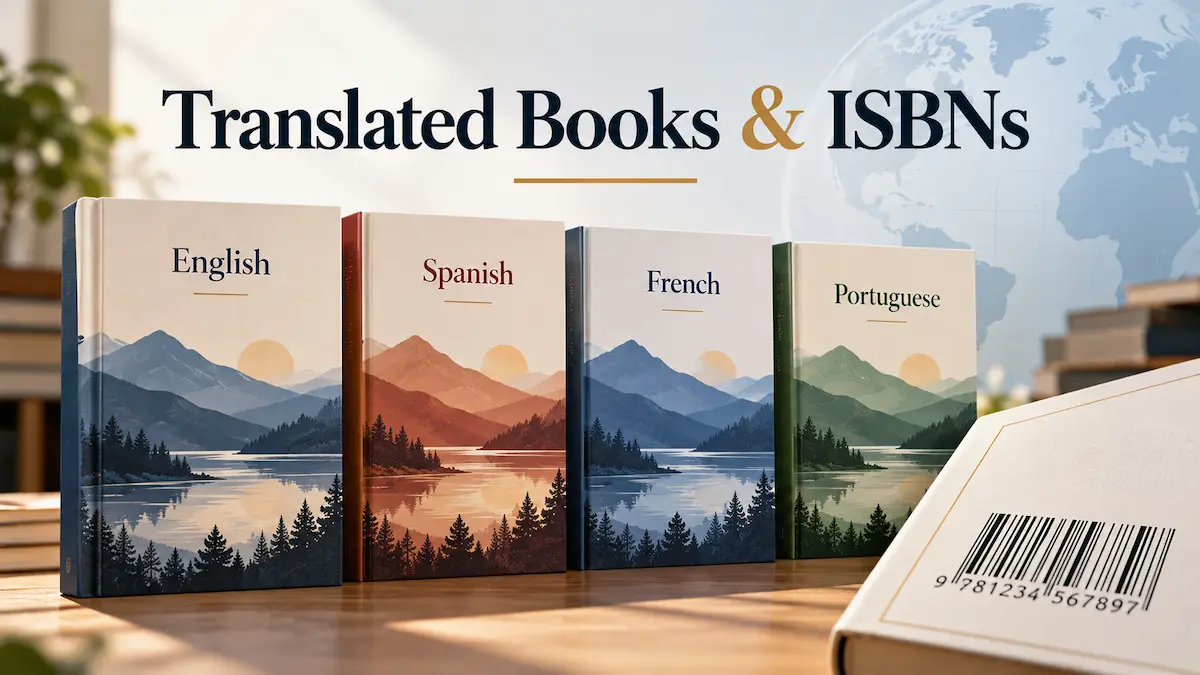
Does a Translated Book Need a New ISBN? A Practical Guide for Authors
Introduction
A translated edition is more than the same book with different words. It is a distinct language edition intended for a different readership, and that distinction matters when you assign ISBNs and publish through retailers such as Amazon KDP.
If you translate an existing book into Spanish, French, German, Portuguese, or another language, you should not reuse the ISBN from the original-language edition. According to the International ISBN Agency, each different language edition needs its own ISBN.
The rules also vary by format. Paperback and hardcover editions require ISBNs on Amazon KDP, while Kindle eBooks can be published without one. This guide explains how ISBNs work for translated books, when a new ISBN is required, and what authors should check before publishing.
Does a Translated Book Need a New ISBN?
Yes. A translated edition should have a different ISBN from the original-language edition.
An English paperback and its Spanish translation, for example, should not share the same ISBN. The translated edition is treated as a separate publication for identification, cataloguing, ordering, and distribution.
The same principle applies when format changes. If a translated title is published as both paperback and hardcover, each print format needs its own ISBN.
There is one important KDP distinction: Kindle eBooks do not require an ISBN. Amazon can identify the Kindle edition using its own Amazon Standard Identification Number (ASIN).
Why a Translation Needs Its Own ISBN
An ISBN identifies a specific publication. Booksellers, libraries, distributors, publishers, retailers, and bibliographic databases use it to distinguish one edition from another.
Changing the language creates a new edition because the book is now intended for a different linguistic market. A separate ISBN prevents the translated edition from being confused with the original when books are ordered, catalogued, distributed, or tracked.
For example, an English paperback, a Spanish paperback, and a French paperback are three different language editions and should have three different ISBNs. If hardcover versions are also published, those hardcover editions require separate ISBNs from the paperbacks.
My Personal Experience With Localized Editions
Around 2022, before generative AI became widely available, I read an article by Dave Chesson of Kindlepreneur about translating books for international markets. I had followed his publishing advice and email newsletters for some time, and that article encouraged me to look beyond the highly competitive English-language market.
One of the services he discussed was Babelcube, a platform that connects authors and publishers with freelance translators through a royalty-sharing arrangement. I joined the platform and spent a month or two trying to find the right translator. Eventually, an experienced Spanish translator agreed to translate one of my best-selling English books. Under our agreement, the first $2,000 of cumulative net sales receipts was divided 30% to me as the rights holder, 50% to the translator, and 20% to Babelcube.
Within a few months of publishing that Spanish edition, I began seeing meaningful sales. That encouraged me to pursue additional translations, including French and Portuguese editions.
Over time, those localized editions became an increasingly important part of my publishing business. By 2024, I was noticing that some of my translated books were selling better than their English counterparts. In recent periods, roughly 70% of my monthly book royalties have come from localized editions sold through platforms including Amazon and IngramSpark.
My experience taught me that publishing in other languages can open less crowded markets and create opportunities that may be difficult to find in English alone. It also reinforced a lesson I have learned repeatedly in business: when someone with proven experience shows you a useful path, it is worth studying that path carefully and testing it for yourself.
Can You Reuse the ISBN From the Original-Language Edition?
No. If a book has been translated into another language, the ISBN from the original-language edition should not be reused.
For example, if an English paperback is translated into Spanish, the Spanish paperback needs a different ISBN. This remains true even if the translated edition has the same author, similar cover design, the same trim size, and substantially the same content.
Using separate ISBNs helps retailers, libraries, distributors, and readers identify the correct language edition.
Do Kindle eBooks Need an ISBN on Amazon KDP?
No. Amazon KDP does not require an ISBN for a Kindle eBook.
This means an author can publish English, Spanish, and French Kindle editions without obtaining an ISBN for each Kindle version. Amazon assigns identifiers that allow the Kindle editions to be listed and managed on its platform.
The rule is different for print. If the same translated book is also published as a paperback or hardcover, those print editions require ISBNs. KDP can provide a free ISBN for eligible print books, or the publisher can supply an ISBN obtained independently.
ISBN Rules for Paperback and Hardcover Translations
For print books, both language and format matter.
Suppose an author publishes the same title in these four versions:
- English paperback
- English hardcover
- Spanish paperback
- Spanish hardcover
All four versions require different ISBNs. The Spanish paperback cannot reuse the English paperback ISBN because it is a different language edition, and the Spanish hardcover cannot reuse the Spanish paperback ISBN because it is a different format.
The practical rule is simple: do not assume one ISBN covers every version of a book. A change in language, format, or a substantial revision can create the need for a different ISBN.
KDP Free ISBN vs. Your Own ISBN
When publishing a paperback or hardcover through Amazon KDP, you can generally either use a free ISBN supplied by KDP or provide an ISBN that you obtained yourself.
A free KDP ISBN is convenient for authors who plan to publish that print edition through KDP. Amazon registers the ISBN, and the publisher information is shown as “Independently published.” A free KDP ISBN is restricted to KDP and cannot be reused to publish that edition through another publishing service.
Using your own ISBN gives you greater control over the publishing identity associated with the book. The ISBN should be registered through the appropriate ISBN agency, and the title, author, format, and imprint information entered on KDP should match the ISBN record.
An ISBN you own can also be used for the same edition when distributing through other publishing services, provided their requirements are met.
For a translated book, choosing between a free KDP ISBN and your own ISBN does not change the basic rule: the translated print edition still needs an ISBN different from the original-language edition.
What If You Revise an Existing Translation?
Whether a revised translation needs a new ISBN depends on how substantial the changes are.
Minor corrections, such as fixing typographical errors or punctuation, do not normally require a new ISBN. A substantial change to the text, however, should be treated as a revised edition and assigned a new ISBN.
A new ISBN may be appropriate if you:
- substantially retranslate large portions of the book,
- add or remove significant chapters or sections,
- make major substantive revisions to the translated text, or
- publish the book as a clearly identified revised or new edition.
Changing only the price, cover color, or making minor corrections does not normally require a new ISBN.
How to Credit the Translator on Amazon KDP
When publishing a translated book on Amazon KDP, the contributor information should accurately identify the people responsible for the work.
For a translated work, the original author and the translator should both be credited in the KDP contributor information. For example, if a book by Jane Smith is translated into French by Marie Dupont, Jane Smith should be identified as the author and Marie Dupont as the translator.
The information entered during book setup should be accurate and consistent with the edition being published. Authors and publishers should also confirm that they control the necessary translation and publishing rights before releasing a translated edition.
A Simple ISBN Example for a Translated Book
Suppose an author publishes a book called Building a Successful Business in English and later releases Spanish and French translations.
The print editions might be organized like this:
- English paperback — ISBN 1
- English hardcover — ISBN 2
- Spanish paperback — ISBN 3
- Spanish hardcover — ISBN 4
- French paperback — ISBN 5
- French hardcover — ISBN 6
Each print edition has its own combination of language and format, so each needs its own ISBN.
The Kindle editions are different because KDP does not require an ISBN for eBooks. Planning this structure before publication makes it easier to keep multiple editions organized.
Common ISBN Mistakes Authors Make With Translations
Common mistakes include:
- Reusing the original-language ISBN for a translated edition.
- Using one ISBN for both paperback and hardcover versions.
- Entering ISBN details that do not match the ISBN agency record when using your own ISBN.
- Trying to use a free KDP ISBN outside KDP.
- Leaving out the translator from the contributor information for a translated work.
- Reusing an old ISBN after a substantial revision that should be treated as a new edition.
Avoiding these mistakes can prevent metadata problems and make it easier for retailers and distributors to identify the correct edition.
Checklist Before Publishing a Translated Edition
Before publishing, check the following:
- Confirm that you have the legal right to publish the translation.
- Do not reuse the ISBN of the original-language edition.
- Use separate ISBNs for paperback and hardcover formats.
- Decide whether to use a free KDP ISBN or an ISBN that you own.
- If using your own ISBN, make sure the title, author, format, and imprint match the ISBN agency record.
- Remember that Kindle eBooks published through KDP do not require an ISBN.
- Credit the original author and translator correctly.
- Check that the selected book language matches the manuscript.
- Keep the cover, manuscript, and metadata consistent.
- If the translation has been substantially revised, determine whether it needs a new ISBN.
- Keep a record of which ISBN belongs to each language and format.
A simple publishing log containing the book title, language, format, ISBN, and publication date can make multiple editions much easier to manage.
Frequently Asked Questions
Can I use the same ISBN for the original book and its translation?
No. A translated edition is a different language edition and should have its own ISBN.
Does every translated book format need a different ISBN?
Yes, when an ISBN is required. Paperback and hardcover editions need separate ISBNs.
Does a translated Kindle eBook need an ISBN?
Not on Amazon KDP. KDP does not require an ISBN for eBooks.
Can Amazon KDP provide a free ISBN for my translated book?
Yes. KDP can provide a free ISBN for eligible paperback and hardcover books.
Can I use a free KDP ISBN with another publishing platform?
No. A free KDP ISBN is restricted to KDP. If you need broader distribution flexibility, you can obtain your own ISBN through the appropriate ISBN agency.
Do small corrections to a translation require another ISBN?
Usually not. Minor corrections normally do not require a new ISBN, but a substantial revision does.
What happens if I publish the same book in three languages?
Each language edition should be identified separately. For example, English, Spanish, and French paperback editions would require three different ISBNs.
Need Help Publishing Your Book in Another Language?
Publishing a translated edition involves more than converting words from one language to another. Authors also need to consider translation quality, editing, formatting, cover adaptation, metadata, ISBN assignment, platform requirements, and distribution.
AB Publisher LLC provides multilingual publishing support for authors who want to prepare and publish books for readers in other languages and international markets.
Whether you are preparing a Spanish, French, or another language edition, careful management of the translation and publishing process can help ensure that the new edition is professionally presented and correctly set up for distribution.
Need help preparing or publishing a translated edition? Visit our Services page to learn more about AB Publisher LLC’s publishing and multilingual book services, or Contact us to discuss your project.